

Star City
On Nevada, Herculine, and the fantasy of "trans rights" as a purely state-level issue

This essay was meant to be in LARB. But, since the publication is imploding, I pulled my piece. Here it is.

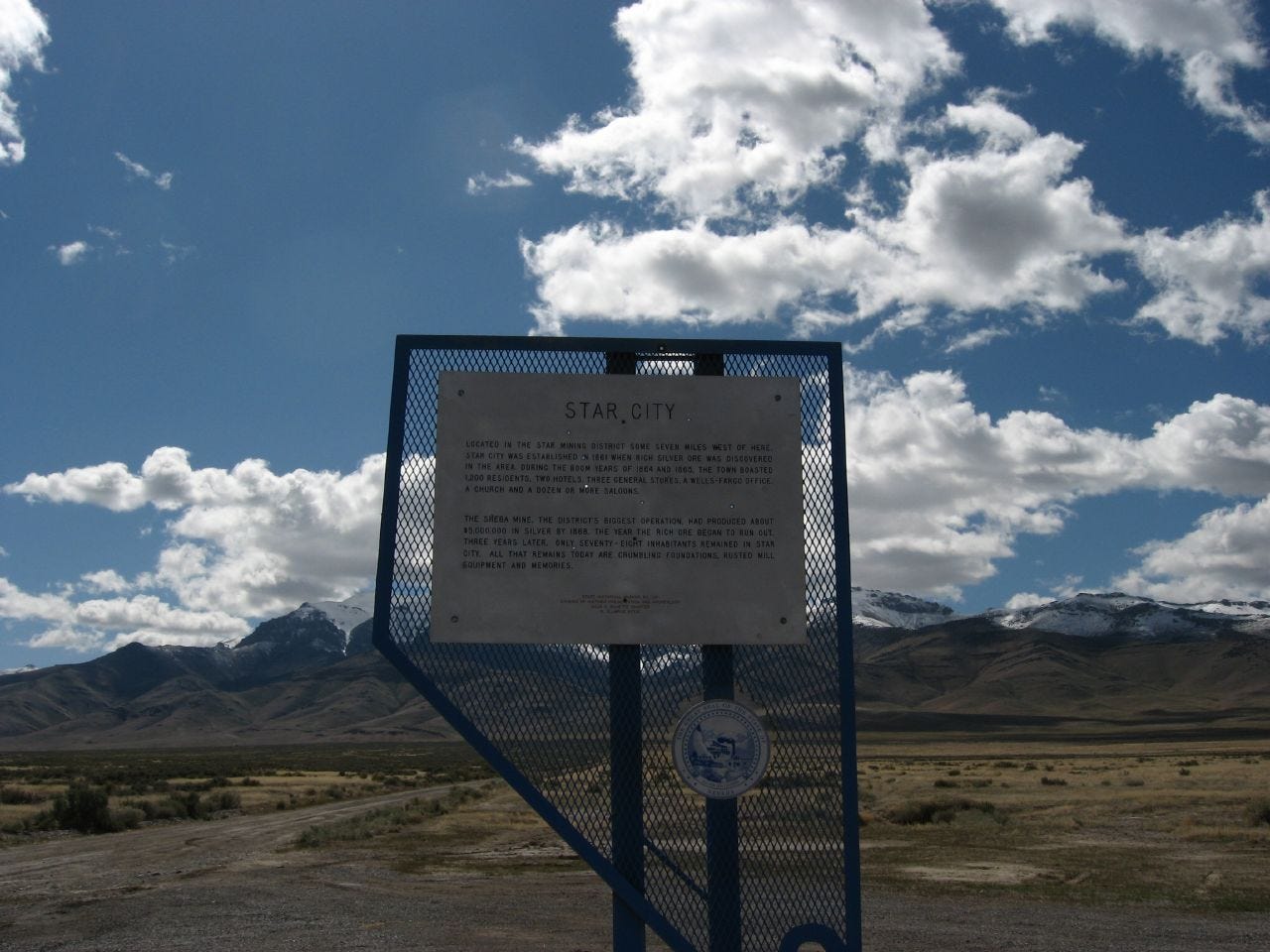
Star City’s silver boom began in 1861 and lasted exactly a decade. By 1868, the mine was producing $5 million in silver ore, enough cash to furnish one bank, two hotels, three general stores, and over twelve saloons. The Nevada town always had more silver than people, even at its zenith. And then the silver began to run out.
By 1871, only 78 people lived in Star City, which is now an official ghost town. “So sudden was its decline,” remarks an 1868 report, “that the daily mail, the express office and the telegraph office are all in operation, though the entire population consists of a single family.” A chainlink sign, shaped like the state of Nevada, flanked by the desert mountain and sky, whispers “that all that remains today are…rusted mill equipment and memories.”
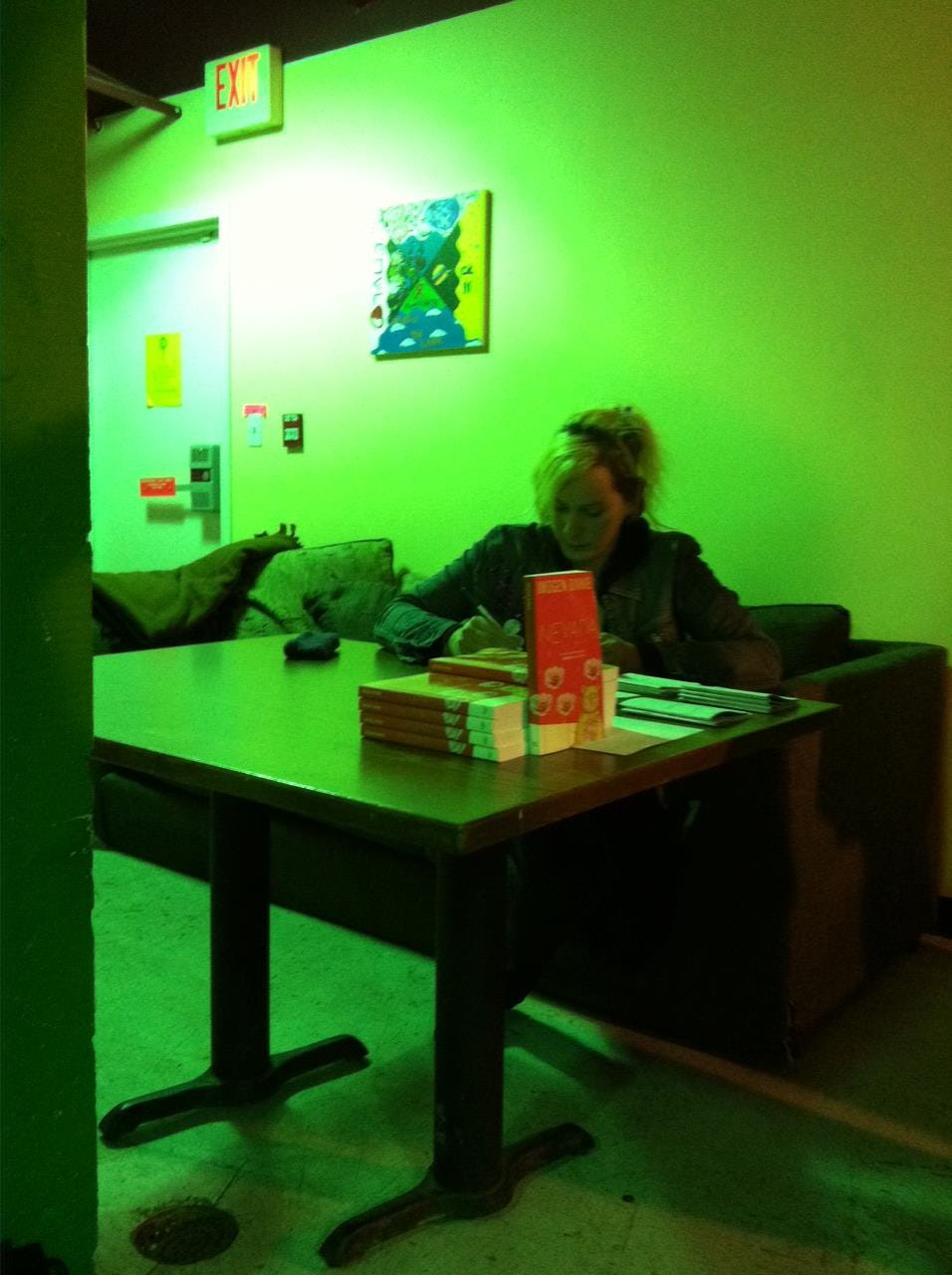
Imogen Binnie’s Nevada (2013), the novel that is often credited with mainstreaming Trans Lit, is set in two locations: New York City, the trans capital of U.S. Empire, and a fictionalized version of Star City, which, in this world, contains a Wal-Mart, a cul de sac, and a parking lot. Herculine (2025), written by Grace Byron, is also split between NYC and somewhere else—in this case, Indiana, where Byron grew up. Her unnamed narrator does ketamine to get through a job working retail at a “kid’s clothing store in Tribeca.” Then an ex invites her to a rural trans girl commune in the Indiana woods.
Together, Herculine and Nevada historicize the period in which “trans rights” was imagined to be a purely state-level issue. Political differences (or so the fantasy went) could be contained by geography: as with abortion and immigration, there would be “good states” and “bad states,” a move rooted in the “states rights’ strategy” that the antebellum South used to justify slavery. But last night’s State of the Union address, in which Trump proposed federally banning trans healthcare for kids, was a reminder that the era of “trans rights” as an exclusively state-level issue is definitively over.
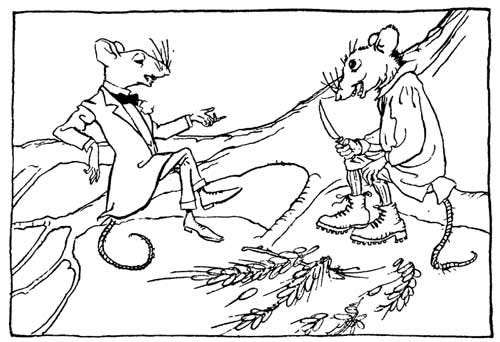
Nevada and Herculine narrativize the consequences of that legislative fantasy through a reverse heroine’s journey. While Aesop’s Fable has the Country Mouse visit the big city, get attacked by a cat, and then return home, grateful––Byron and Binnie show the reverse geographic movement. Both novels begin in the Big Apple. Until, suddenly, our transplant protagonists––in a move that is equally pent-up, long-term immiseration and self-sabotaging, self-releasing spontaneity—leave New York.
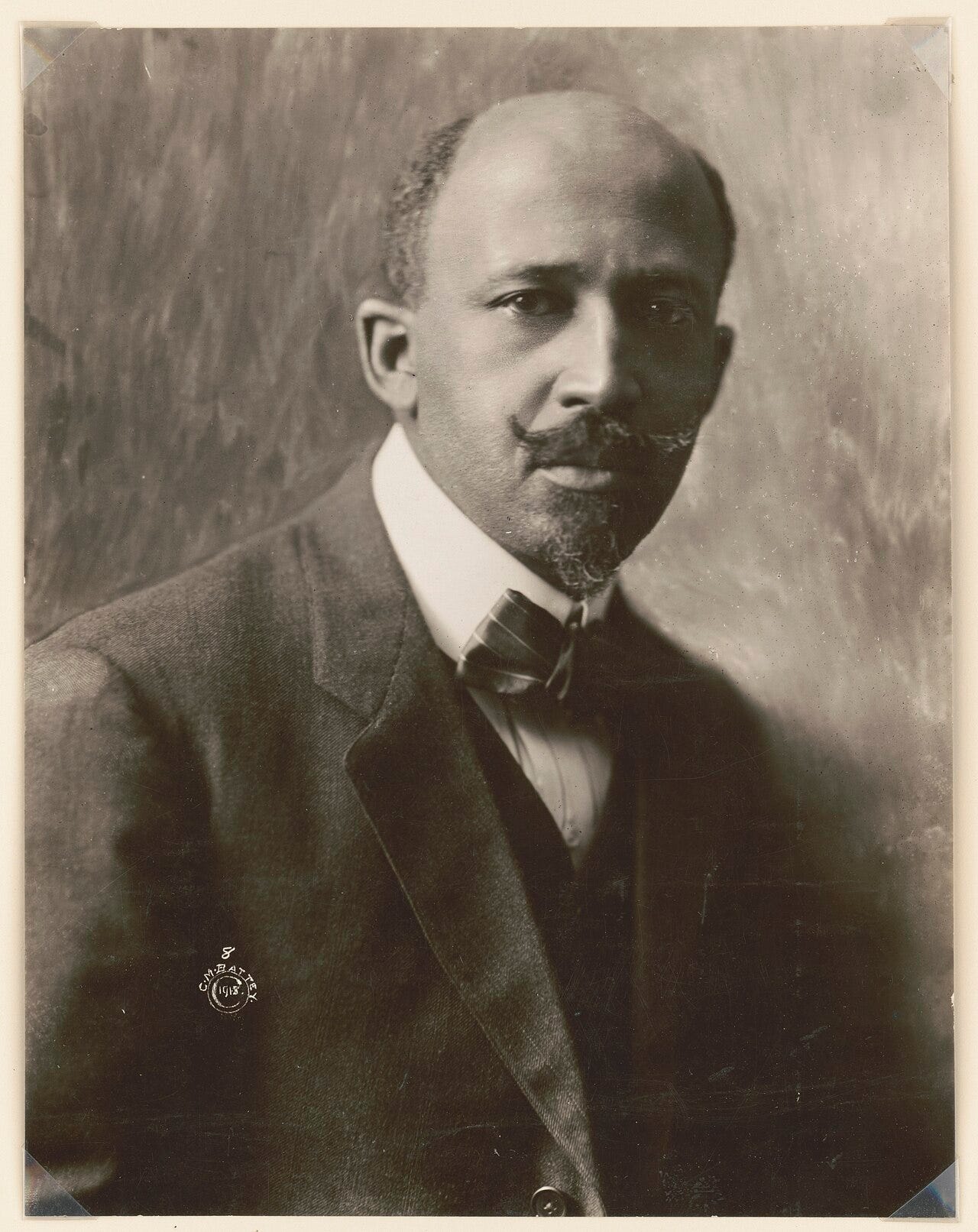
The most infamous instance of “states rights,” the one usually being asserted explicitly or winkingly in contemporary contexts, comes from the Civil War, where it was deployed as a pro-slavery euphemism. In Black Reconstruction (1935), W.E.B. Du Bois maps out the South’s economic explanation for its “states rights” strategy. “The argument went like this: raw material like cotton, tobacco, sugar, rice, together with other foodstuffs formed the real wealth of the United States, and were produced by the Southern states.” Since slavery was the cheapest way to produce this “real wealth,” then slavery should stay.
However, as Du Bois also points, this was never a purely economic argument. If the South had not also been driven by libidinal anti-Blackness, they would have outlawed slavery, which de-incentivized them from industrializing the plantation economy. “They might have moved forward with manufacture and been able to secure an approximately large amount of profit,” Du Bois writes. “But this would have involved yielding to the demands of modern labor: opportunity for education, legal protection of women and children, regulation of the hours of work, steadily increasing wages…” This contradiction was never worked out. While the end of the Civil War promised to coagulate America into a single nation, the Reconstruction-era “Black Codes,” soon to be known as “Jim Crow” laws, allowed specific states to maintain anti-Black apartheid policies.
Just the South’s “states rights” strategy ran cover for broader federal agendas, classifying transness—or abortion, or immigration—as a purely state-level issue was always part of a federal power grab. Stinging from Obergefell v. Hodges, which legalized gay marriage in 2015, American conservatives responded to a nation-wide pro-gay consensus by pushing through anti-trans legislation at the state level, starting with North Carolina’s 2016 HB2 law, known as the first “bathroom bill.” Instead of locking in trans rights at the federal level, liberals instead pursued the same strategy they pursued with abortion and immigration: strengthening protections in blue states, while being hands-off in red states.
But, even then, the idea that “trans rights” could function as a purely state-level issue was always a fantasy. By the time North Carolina passed HB2 in 2016, gender-affirming healthcare had already (albeit accidentally) been enshrined by the Affordable Care Act’s Rule 1557 in 2010. We can see the same kind of discrepancies across immigration policy. While Chicago declared itself a “sanctuary city” in 1985, ICE agents were still legally allowed to enter this past September as part of Operation Midway Blitz, since the Department of Homeland Security, a federal body, was permitted to override state jurisdiction.
To some extent, this legislative overlap between state and national control is intentional. The constitutional distribution of power known as “American Federalism” was designed to be a system of checks and balances between executive and local offices. This is not, of course, how it has played out. Instead, trans policy is yet another way for the unresolved battle between federal and state power to ricochet.
Since the overturn of Roe v. Wade, roughly 130,000 residents have moved out of states with near total abortion bans; a 2024 study, performed before Trump’s second term had even begun, found that roughly half the trans people in America had considered moving to a different state. Which means they’ve probably considered moving to New York, home to more trans people than any other American city—and, famously, one of the most expensive places in the world. Nevada and Herculine are about trying to live out these geographical dead ends. They’re about the false choice between healthcare and housing, between a social life and financial stability.

Both books show what it’s like to grow up as the “only one” in a small town amidst ignorance and neglect. Maria, Nevada’s protagonist, was a teen in rural Pennsylvania in the nineties. “She was supposed to be a boy. She hadn’t figured out yet that she wasn’t one. She knew something was weird, she had long stringy terrible hair that she wouldn’t let anybody cut, the insinuation of an eating disorder.” Maria goes camping with her friends. They hang out in farms and sit next to cows and do heroin.
In Herculine, the narrator’s hometown is more suburban, the kind of place defined by strip malls, churches, and “cheap small-town food. Grits, pancakes, burgers, shakes, and those awful pale fries.” Her parents are Evangelical. They send her to conversion therapy.
Both Maria and Byron’s narrator eventually move to NYC; but their lives there, set almost a decade apart, are quite different. Maria has only one IRL trans friend, Piranha, who works at a Rite Aid near Brighton Beach. Maria works retail at a bookstore (modeled off the Strand, where Binnie once worked). Both Maria and Piranha are the only trans people at their jobs. When Maria goes to a support group at the Gay Center, it’s mostly older crossdressers who “weren’t transitioning, they had convinced themselves not to.” New York’s vogue and ballroom culture of course exist, but Maria is too white. She talks to other trans people on the internet.
Herculine’s unnamed narrator, in contrast, is not just hanging out with other trans people IRL, she’s also fucking them. She checks to see if Max, her “trans boy of the hour,” has texted her back yet (he hasn’t). Who is he texting instead? Who is he fucking instead? While Maria had to grind to find other trans people, Byron’s protagonist is surrounded. Maria only has one trans friend, but Byron’s narrator has a trans girl friend group. There’s Xiomara, who had “held my hair back in the bathroom”; there’s Nora, who “was particularly alluring because she used to live in Berlin.” There are multiple ways to get HRT and surgery. There are trans comedy shows, poetry readings, club nights, and sex parties.
But not every trans person is a potential friend or lover. In New York, where rent is roughly 150% higher than the national average, trans people must compete against one another (and, of course, compete against cis workers) while being statistically predisposed to employment discrimination that is compounded along race and class lines. Both Maria and Herculine’s narrator get fired, but at least they manage to get jobs in the first place. As historian Jules Gill-Peterson has shown, trans misogyny and empire have historically tried to push black and brown trans women out of the formal labor market entirely, making it easier to police and arrest them for e.g. sex work, drugs, or “vagrancy.”
Writing was supposed to be the narrator’s way out. Or, at the very least, it was supposed to be…something. Instead, she finds that the only writers who can really make it are those with inherited wealth and high-paying day jobs, or those who can glide through a literary social scene dictated by cishet desirability standards. Byron calls them the “Hot Freelance Girls.”
None of this is tenable. None of it was designed to be. It’s Temu life insurance. Maria’s girlfriend breaks up with her. Maria gets fired. Even Piranha is sick of her shit. Even New York, the land of gay opportunity, can lead nowhere. Maria steals her ex’s car and, with a suicidal dose of heroin, purchased with her bottom surgery savings, begins to drive.
For Byron’s narrator, the downward spiral is similar. She’s fired; Max breaks up with her (they’d only hung out “twice”). Plus she’s hallucinating demons again. “Most days I woke up at three in the morning in a cold sweat, face to face with a sleep paralysis demon. Sometimes I would cower in fear. Sometimes I would ask it what Satan thought about #MeToo.” Finally, she agrees to join Ash in Herculine, where the girls sleep in tents and cabins like summer camp, and the woods are far, far away from everyone, just like in a nightmare. Maybe it’ll be fine. It’s less that she really believes in trans femme rural utopia, and the not having to pay New York rent.
Having been a New York novel, and then a road novel, Nevada suddenly flips into a partial bildungsroman. Maria winds up in Star City. She is perusing the CD section at the town’s only Wal-Mart when she meets James—who, almost instantly, realizes that he is probably also trans. James is twenty. He has a girlfriend, Nicole, who he doesn’t really like. The only thing he likes is smoking weed. Binnie actually has James narrate the second half of the book, a move that also allows us to see Star City from a hometown POV.
Meanwhile, literal demonic possession breaks out in Herculine. Again, the genre shift, as a New York novel becomes a horror story. Satanic pregnancy and murder ensues. After multiple spiritual exorcisms, plus a confrontation with her Evangelical family, Byron’s narrator comes back to New York. She’s relieved. But she’s also ambivalent. Back to New York rent.
In Sex is as Sex Does (2022), Paisley Currah analyzed the “the lack of a universal standard for classifying people as male or female.” In addition to these state-to-state discrepancies, local government offices are often run by their own rules. The DMV may say one thing, while the marriage license office says another. If biological essences are a myth, then so, as Currah shows, was the “state,” which, in the material, quotidian reality of sex classification, operated less as a coherent unit than as a “Kafkaesque” amalgam of administrative offices.
As Currah also noted, splitting trans healthcare and policy into fifty different state-level modules enforced a “divide and conquer” strategy. Instead of rallying against a single federal ruling, trans liberation movements were siloed into combatting the laws in their specific states; sometimes these fights were transferable across state lines, and sometimes the legislation between those states were so different (again, by design) that such solidarity across geographic difference was deemed unfeasible.
But our enemies are no longer playing a state-level game. On January 20th, 2025, the day of his Inauguration, President Trump issued Executive Order 14168, which federally defined sex and gender via “Biological Truth.” On February 19th of this year, the Trump administration proposed ending gender-affirming care in federal prisons. And, as with immigration, the “good states” are no longer the beacons they were supposed to be.
And neither is NYC. On Tuesday, NYU Langone officially banned trans healthcare for minors. The move is likely in violation of New York Human Rights Law, but threats to their federal funding forced NYU to push the policy through anyway.
It’s raining in New York. “Sheet cake rain.”
Drinking coffee at a Coney Island diner, Xiomara asks about Indiana. But there’s no way “to explain the demonic.” Instead of trying, and as a way to put off applying for jobs, our narrator goes to the aquarium, alone, walking down “a long tunnel of grinning sharks.”
Maria never ends up convincing James to be trans. She is playing a Munsters slot machine in Reno when he leaves her there, hitching a ride with Nicole.
There is no good state/bad state. There is only one hell world.

With thanks to: Akhil Vaidya and Eli Erlick for editing assistance; Jules Gill-Peterson for research advice; and tasbeeh herwees for her reportage.
Charlie this is a brilliant periodization.
Love all the threads that are pulled together here & I haven’t read Herculine but now I want to.
Your piece also made me think about how New York is the city of stars and Maria is a fallen star that lands in star city, a town that looks up to the stars. And here we live in a timeline where some deliberately wants to shoot down all the stars and that’s fucked up.
Thank you for this.