

Sleep Talk
A short story about a man who talks in his sleep

Jared was normal, not in an aggressive way, but just like he was super chill and could instantaneously meld into any social situation, not just fluidly but happily, seemingly, which meshed with Lily’s desire to be a positive person who was optimistic about life.
The only really weird thing about Jared, which she discovered on their third date, was that he talked in his sleep. Sometimes, it was just mumbling. Other times, he was locked in a Model U.N-ish Socratic mode
“I don’t think that’s a wise position to take,” said Jared to her bedroom wall. “Speaking honestly? And can you?”
His voice entered the parameters of Lily’s own dream. Maybe he wanted to dream the same dream as her; he was trying to reach her there. They were like two fish, destined to interact at the floor of the ocean, caressing the liquified nickel and iron alloys inside the world’s secret core.
When Jared spoke to her in his sleep, did he want her to wake up?
Sometimes, he seemed angry. He was fighting with someone. One night, after a frankly normal dinner with their mutual friends, and after that, also normal, going on their phones and then nodding off, she was awoken by Jared screaming.
“DONT FUCKING TOUCH THAT,” he said. “IM DONE WITH YOU ACTING LIKE A LITTLE BITCH.”
“Jared?” She put her arms around his body. “Baby? What’s wrong?”
But he was asleep again.
It is interesting to have someone be so famous, so the only one of their kind, that when the rest of the world catches up, instead of embracing you, the anti-hegemonic consent having been manufactured, you’ve become passé, or maybe you fell off, and if so, why?
All of which is a way of asking what happened to Michael Moore.
Jared doesn’t remember his dreams.
What are dreams if you really think about it?
It could be that he’s just hungover or it could be the k or it could be he smoked or it could be he just doesn’t want to know and who can force him honestly? The question he keeps jutting up against. Who can even make me fucking do anything?
He doesn’t mean it in an aggro way. Ensconced within different circumstances, the question could be playful, could mean anything.
As could the title of Michael Moore’s 2002 documentary, Bowling for Columbine, which he turned on the night Lily said he woke up screaming which he couldn’t remember, it was just that a certain point, he was awake, and he was telling her he was okay, and she just said, “But you’re screaming.”
“I couldn’t hear myself.” And, genuinely, it was true.
He’d assumed that Moore was doing an infinite play of signifiers, but Bowling for Columbine actually meant something quite specific, or so he learned, watching on his laptop in the living room, as Lily slept. The morning of the Columbine massacre, Eric Harris and Dylan Klebold were said to have gone to a 6am bowling class before massacring their fellow Pacific Northwest students at 11:17am.
They hadn’t gone bowling, though; they’d skipped school.
If you look up Eric and Dylan, the first auto-generated response is “graves” and “where are they.”
Michael Moore is a joke now. But in Bowling for Columbine, he is magnificent. Not just because the film links US gun violence to US imperialism (the biggest employer in Littleton, where Columbine is located, is Lockheed Martin), but because he doesn’t care about woke. Woke doesn’t exist yet. It’s 2002.
All that exists is Michael Moore––born in Flint, Michigan––his righteous, extremely tall body; his multi-pronged, diamond-bright rage.

Lily remembered her dreams. It had been like that since childhood. Not all of them, not all the way through, she isn’t delusional. There was just less of a barrier between her dream and non-dream life. Time moved strangely there, but in a way you could still understand.
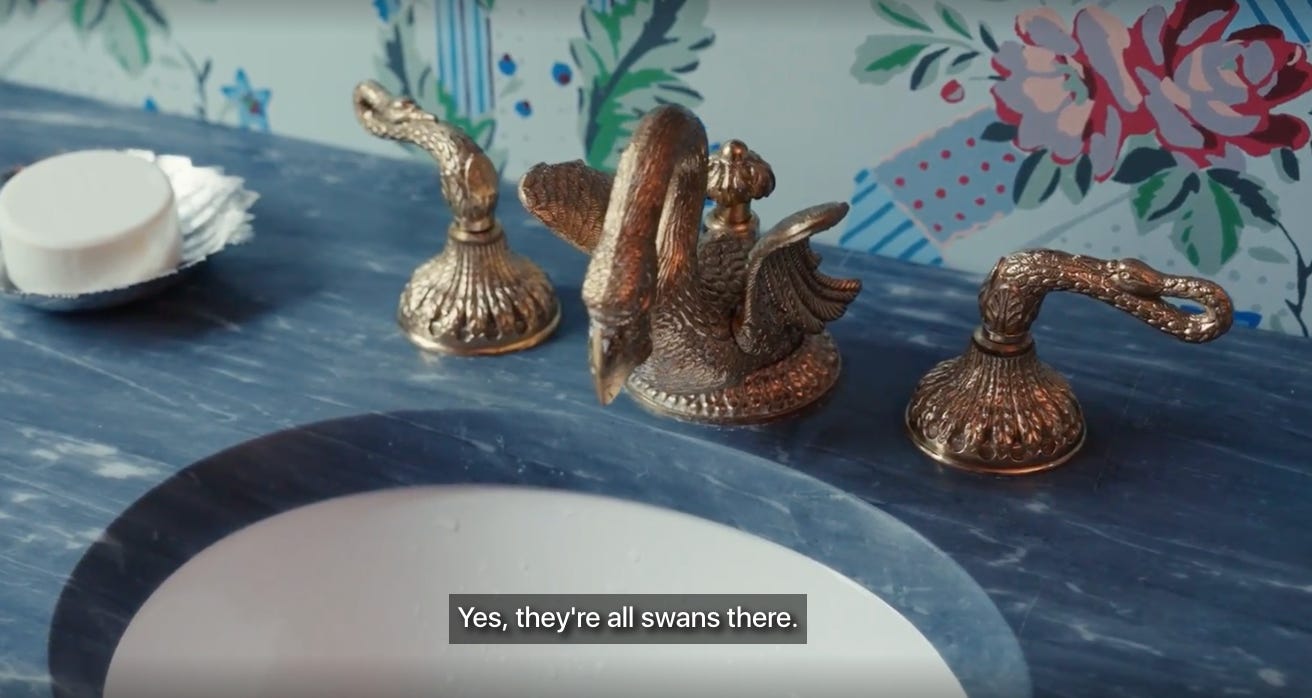
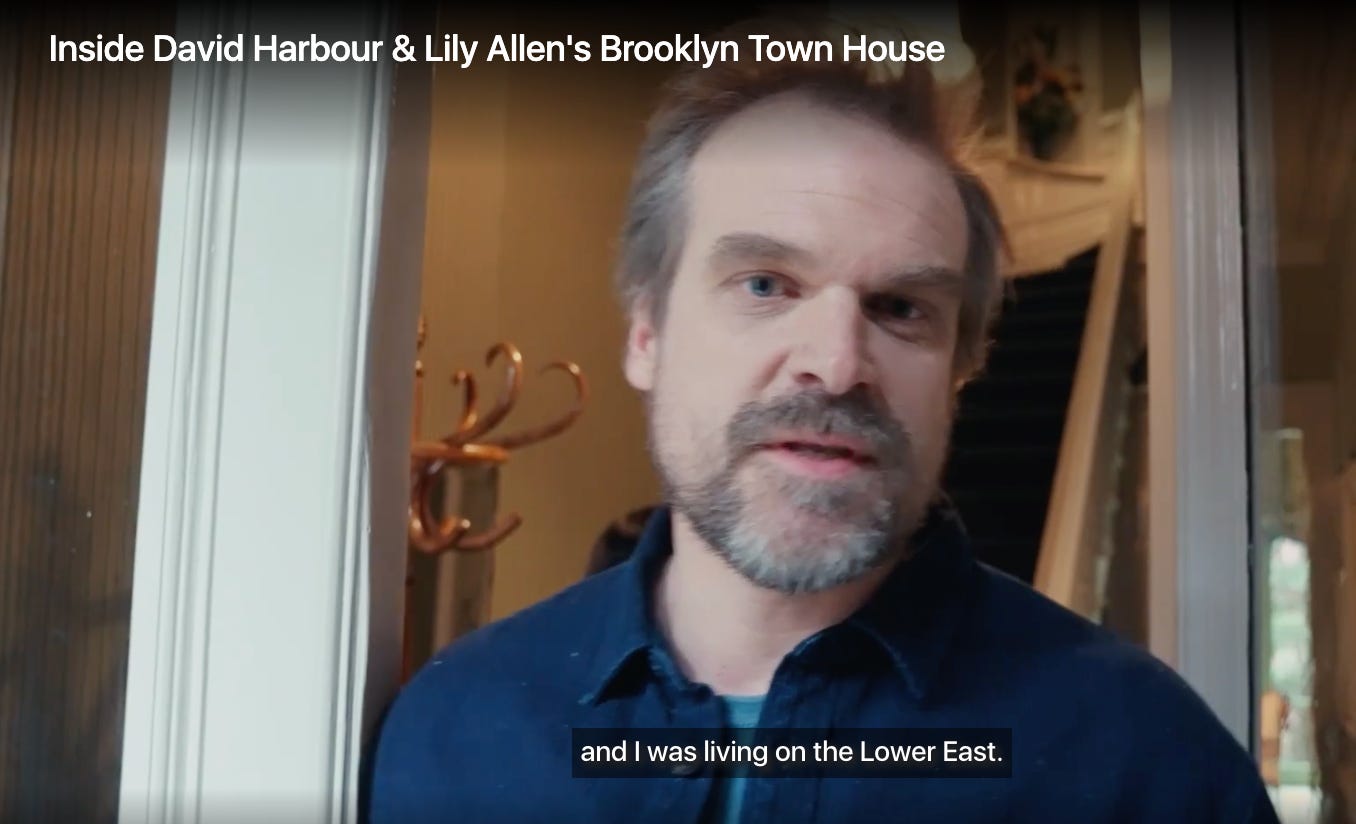
She is in the Architectural Digest short Lily Allen made with her then-husband, David Harbour, who is the dad in Stranger Things, and they are showing her the faucets in the master bathroom, which are all shaped liked the necks and wings of swans, and they are taking her into David’s bedroom and explaining why it is window-less.
The opposite of goon is castration.
Is David Harbour a castrati, locked up in the chastity belt of his windowless room? Or has the gooning lifestyle, online and in-person, superseded his need for light?
“That’s how history advances, plugging its memory as one plugs one’s ears,” writes Chris Marker in Sans Soleil.
She isn’t sure why she’s dreaming of Lily Allen, and also whether or not this dream is sexual, whether she wants it to be. Lily Allen is describing the pros and cons of blackout curtains. She has a bob; she radiates energetic despair. Lily wants to tell Lily Allen that she knows, not just what’s been happening, with David and the cheating and the playing tennis with girls who were meant to just be one-night stands, but that Allen will vindicate herself culturally with a break-up album featuring dancehall hits.
Lily Allen looks at a swan faucet, meaning and significance coursing through her polka dot knee-high boots and also flesh.
“Speaking honestly?” says Lily Allen in Jared’s voice. “And can you?”
Moore is from Flint, Michigan, former General Motors headquarters; his uncle, LaVerne, helped found the United Auto Workers Union (UAW). After the Great Depression “ended,” GM never rehired all the workers they laid off; when wages rose nationally, they did not rise at GM.
The genius of UAW workers like LaVerne was that, instead of organizing individual plants, they centralized, going after GM, the biggest and most notorious employer in the auto industry. On December 30th, 1936, workers at the Flint Fisher #1 factory stopped working; they began an occupation of the building; they refused to let management inside.
The strikers—fed, in part, by a diner across the street, which let them eat free—only left once GM formally recognized the union and raised wages. The strike lasted forty-four days.
I have thus far presented a braided narrative:
A-plot: the sleep talker, who can’t remember what he says; his girlfriend, who has to remember for him, and also remembers her own dreams
B-plot: Michael Moore, his life and career forgotten with the same amnesiac rigor that “forgot” the War on Terror so as to rinse and repeat imperial conquest in the region
C-plot: less a plot than necessary miscellany, B-roll, the “secret third thing.”
In 2666, Roberto Bolaño describes life as “supply + demand + magic”
Within this narrative structure, the Flint Sit-Down Strike is C-plot, as is Columbine, even though they are A-plot in terms of actual U.S. history
Jared’s PCP asks if he sleeps with the window open and shut.
“Open,” he says.
When he gets home, as they are preparing for bed, Lily notices that he shuts the window instead of opening it.
The spectacle of male castration is hardly spectacular if you are, by definition, a castrati, either because you were born that way, or because you did it to yourself.
It is not surprising, considering the content of his work, and yet surprising, considering how much of it there is, that Michael Moore never filmed himself having sex.
Terry Goon, the protagonist of Theda Hammel’s Stress Position (2024), would film himself having sex if anyone wanted to watch. The problem is that no one does, other than his maybe predatory ex.
One of the taglines for NYMPHOWARS, Macy and Theda’s podcast, is, “Get your cocks out!” A paeon to the digital goonathon which is podcasting itself, the promise of endless parasocioal audio content that you can multi-task to.

“The first image he told me about was of three children on a road in Iceland, in 1965,” says the narrator of Chris Marker’s Sans Soleil in the opening shot.
“He said that for him it was the image of happiness and also that he had tried several times to link it to other images, but it never worked.”
This is the image that comes next:

When Sans Soleil was released in 1983. Did people believe in the future then?
On May 5th, 2013, I saw Sans Soleil in Chicago for the very first time. I was 21. I don’t know who that person was.
In an official U.N. document, the United States reported that, in 1983, its population had achieved a literacy rate of 99%. Today, only 79% of American adults are literate, a skidding, atrocious drop compared to just two decades ago.
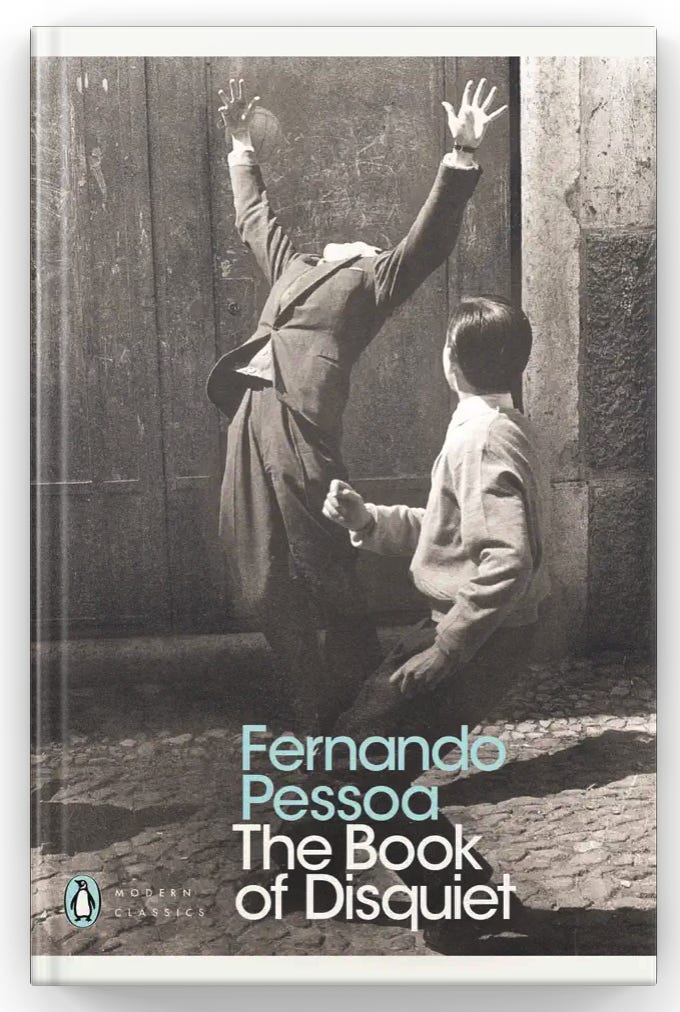
At the East Village coffee shop designed to resemble a 2006 Williamsburg loft and also a Beach Boys-esque surfing lifestyle, as if embodying both coastal elitisms simultaneously, the model-y barista, who looks both Abercrombie cheerleader and mall goth, is reading The Book of Disquiet by Fernando Pessoa, published almost four decades after the author died, in Lisbon, in 1935.
I ask her if the book was hard to get into.
“I just started it last night,” she says. “But look.”
She puts her thumb in the paperback and opens it. She’s at page 56.
Most of my students who major in nursing already work full-time as home health aides. One of them hits herself on the head in order to stay awake. When she falls asleep, I don’t have it in me to wake her. No one reads outside of school because no one has free time.
The coffee shop has started a micro-press.
Literacy is fetishized because fewer people can read. Commodities become aspirational based on scarcity. The niche experimental literature craze is the inverse of a national crisis in literacy.
Maybe that’s why you’re reading this sentence, right now, today.
In our discussion of “The Book of Martha,” an Octavia Butler short story, one of my students says that resentment is the pain you both didn’t and didn’t decide to give up.

That night, Jared sleeps perfectly. When he wakes up, he finds that Lily is still sleeping. That hasn’t been true since…I don’t know. He finds himself going into the kitchen, putting a coffee filter in the machine. He remembers it, the little spinny thing that Lily always forgets to use…Ok. Yes. The handheld frother. Unless… are we…?
Opening the fridge, he sees the familiar, happy red milk carton. How long has it been there, waiting for him? He goes to check the expiration date, and finds the numbers becoming soup in front of his eyes. When he flips the carton around to confirm the milk brand name, he find that he can’t.
Read the name of the brand, that is.
It’s not that his vision is off. He can still see perfectly. Lily wears glasses; he doesn’t. When he holds his finger up, moves it lateral, vertical, just like his PCP did during yesterday’s physical exam, he can observe each aspect of his body part: nail bed, finger tip, whorl of skin. It’s just that the words themselves mean nothing anymore, are an assemblage of color and light.

Post-Script: On Monday, Walter Lucken IV guest-posted about Catfish; his piece also dealt with masculinity and Michigan, though in a non-fictional way. After I finished this story, Walt told me that he used to get “debilitating insomnia and night terrors like the character in the story.” Akosua T. Adasi told me it was fine to post on Sundays; Akhil Vaidya told me it was fine to like “documentaries with a strong point of view”; wiv watched the Moore doc with me. If you’re interested in more fiction, you can pre-order Jaw Filler. If you got this email twice, it’s because I experimented with scheduling posts. I will never do that again…

We need Michael Moore back!
fetishization of literacy....